


Oncology VBC has focused heavily on who owns risk. The next layer may be who owns the work underneath it: supportive-care infrastructure that prevents late escalation, keeps patients in treatment, and helps risk-bearing models perform.
Cancer’s Underbuilt Middle
I’ve been thinking about a simple but underappreciated point in oncology. Cancer care is no longer simply an acute diagnosis or end-of-life cost problem. More people are living longer with the disease, creating an underbuilt “middle journey” where otherwise minor care gaps quietly drive swings in financial risk.
The American Cancer Society projects 2.1M new cancer cases in the U.S. in 2026, while five-year relative survival rates across all cancer types reached 70% (up from 49% in the 1970s) (ACS). More people are being diagnosed. More are living longer after diagnosis.
For payers, cancer is no longer only a terminal cost problem. Patients move through treatment, recovery, recurrence, and, sometimes, decline. Along the way, unmet support needs can show up as missed visits, delayed hospice conversations, and interrupted care plans.
None of that shows up neatly on the payer P&L. It materializes later via emergency department visits, inpatient admissions, and avoidable treatment delays.
This is the part of oncology cost management that feels underbuilt.
The Cost Mechanism
The obvious objection is that supportive care does not address drug spend, which remains the center of gravity. In Medicare’s Oncology Care Model (OCM), Part B chemotherapy drugs represented roughly one-third of episode payments, and Part B and Part D drugs were the largest contributors to growth (CMS). Supportive care platforms won’t touch immunotherapy or CAR-T.
Drugs may be the largest cost pool, but acute care is where volatility shows up. A Stanford study of ED utilization by oncology patients found that roughly one in four ED visits ended in discharge, and they estimated that ~10% of all oncology ED visits may be preventable (SHC). Similarly, CMS specifically identified better-targeted ED and hospital admission initiatives as remaining opportunities for cost compression.
That clarifies the opportunity: better infrastructure around treatment that reduces avoidable escalation before patients re-enter the system through the most expensive door.
Who Owns the Work Underneath Risk?
Oncology VBC has spent years asking who should own risk. But owning risk and owning work are not the same thing. A payer, ACO, or oncology platform can hold the contract, but someone needs to engage the patient, close the loop, and prove that the work changed what happens next.
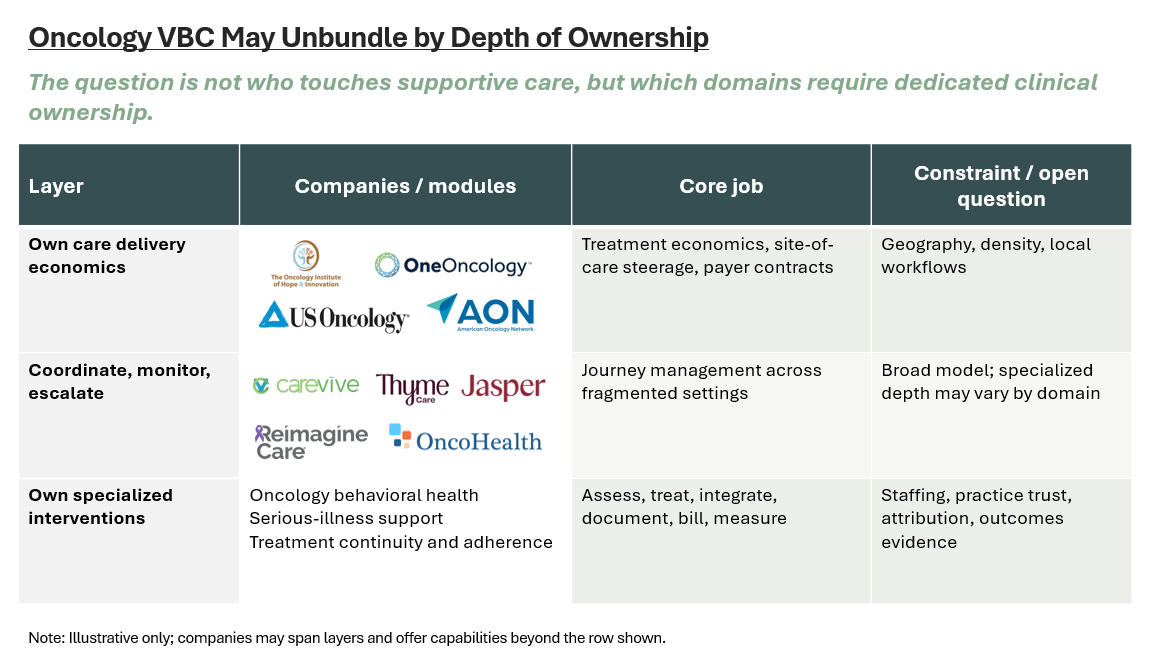
The top layer sits closest to care delivery: practice platforms organized around physicians, local markets, and treatment economics. That proximity gives them leverage over treatment decisions, site-of-care steering, and payer contracts. But they are constrained by geography, patient density, local workflows, and physician alignment.
The middle layer coordinates the journey across fragmented settings. Broad wraparound oncology platforms move patients between oncologists, imaging centers, infusion sites, and pharmacies. They monitor, coordinate, and escalate throughout that journey, and a few already provide clinical resources in specific domains. The distinction is whether specialized intervention lives in their core operating model.
In conversations with oncology operators, a recurring theme is that behavioral health is widely acknowledged but not always operationalized with the depth required.
So coordination may not be the final layer. Some needs are more than routing problems. They require dedicated clinical ownership with a closed loop.
The next layer is likely to emerge where coordination is necessary but insufficient.
Behavioral Health Is a Wedge, Not the Company
Behavioral health is the strongest example. One in four people who have (or have had) cancer experience depression, and cancer-related distress is not generic anxiety (ACS). It can affect whether patients report symptoms late, stop medications, or make serious-illness decisions only after a crisis. General behavioral health networks are not built for rapid access, symptom-aware escalation, or integration with community oncology practices.
Discrete modules also fit where the market is today. Most community oncology practices are not operating inside full-risk arrangements, making broad care management challenging to sell. Behavioral health is a practical first step. The need is visible, and reimbursement pathways already exist.
A useful analogue is the way academic medical centers often partner with community oncologists. At Stanford, we provided specialized input and online second opinions while keeping the community oncologist at the center of the patient relationship. Supportive oncology may need a similar posture: adding specialized capabilities around the oncologist without extending into outright patient ownership.
That said, the long-term play here is not more therapy for cancer patients. It is the operating layer around treatment: finding the right patients, engaging them early, delivering the clinical care, and proving that something changed.
The same logic extends into adjacencies like serious-illness support and treatment adherence. The common thread is not the service line. It is helping oncologists manage risk around treatment without expecting them to build the capability themselves.
The Hard Part Is Proof
Medicare is already pointing in this direction. OCM taught us that payment reform can push oncology practices toward coordinated, episode-based care, but it does not make the work easy to operationalize, nor does it guarantee savings. EOM is the current attempt to sharpen the thesis, asking practices to do more around navigation, access, and quality measurement, but with tighter economics and more risk than many practices are willing to accept.
Model design is not operating capacity. The bear case for supportive oncology is that it becomes another services-heavy care management business with fuzzy attribution and margins that compress as acuity rises.
The Opportunity Is Around Treatment
The next oncology opportunity is probably not another full-stack risk-bearing group. It’s the company that becomes indispensable around the oncologist: specialized enough to manage high-acuity patient needs, light enough to fit into community workflows, and measurable enough to matter to payers.
That’s a harder company to build than the next navigation layer. It has to earn clinical trust and prove the work changes what happens next.
Behavioral health may be the entry point. The larger prize is owning the work around treatment well enough to make risk-bearing oncology models perform.
💭 If this sparked something — share it with a founder, an operator, or anyone thinking about supportive care, oncology, or what value-based care actually requires.
Liked this one? You might also like The Ambient Scribe Stack — a breakdown on how companies like Abridge, Ambience, and DAX are going beyond the note to rewire clinical workflows. Or Modular AI, Trust, and Saying No, on how Camber is building trusted RCM infrastructure for the independent clinics most vendors ignore.
In-Network is where I write about the business of care: models, margins, and the infrastructure behind how we deliver it.
→ Subscribe for sharp, honest analysis on what’s actually changing in healthcare.